Why AI Works, But Your Strategy Doesn't
Most companies celebrate their AI wins while their coordination falls apart.
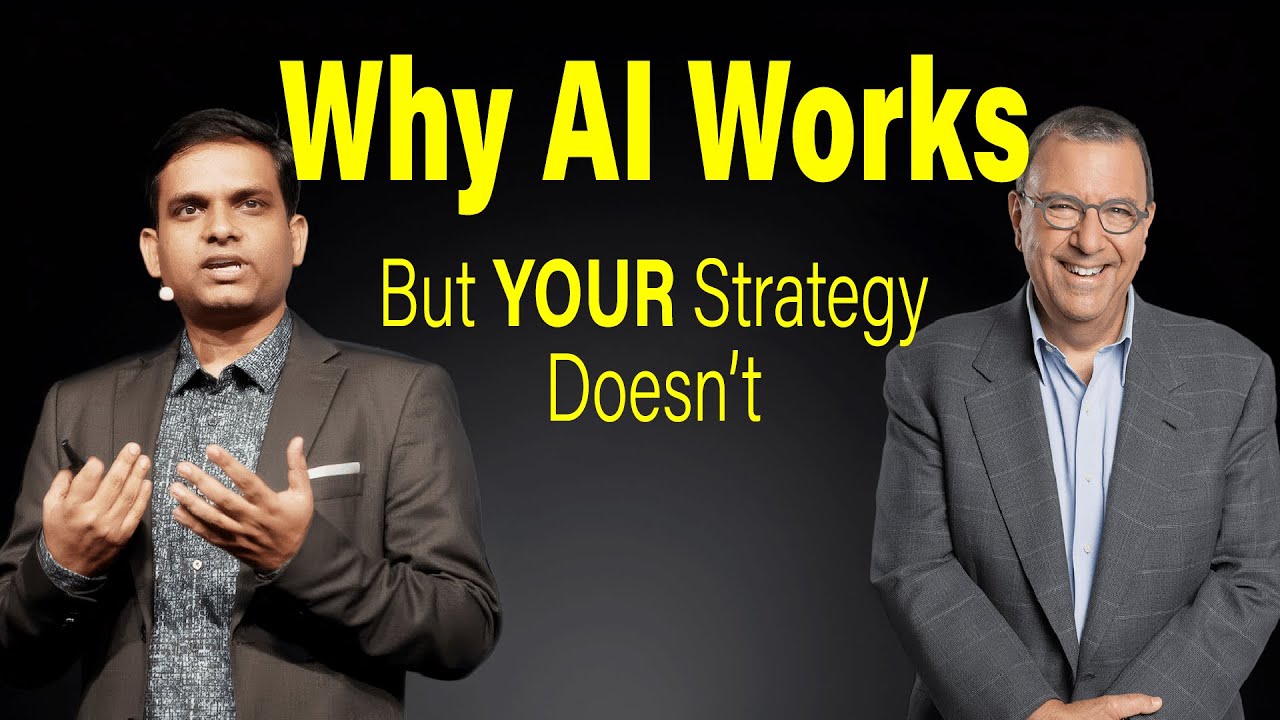 Watch on YouTube
58:47
Watch on YouTube
58:47 
Every AI efficiency gain creates new coordination costs. Discover how to build systems that scale across fragmented teams, in a conversation with prominent author Sangeet Paul Choudary on CXOTalk episode 900.


Most companies celebrate their AI wins while their coordination falls apart. Teams move at different speeds, handoffs break, and the faster you automate individual functions, the slower your business becomes. Sangeet Paul Choudary, bestselling co-author of Platform Revolution and author of Reshuffle, explains why this isn't an execution problem; it's a fundamental misunderstanding of what AI actually does.
Choudary, who has advised CEOs at over 40 Fortune 500 companies and serves as Senior Fellow at UC Berkeley, argues that treating AI as automation technology creates speed mismatches that destroy coordination at scale. When marketing's AI outpaces sales, or engineering moves faster than operations can absorb, organizations don't get efficiency; they get fragmentation. The real opportunity isn't automating tasks; it's leveraging them by building coordination infrastructure that enables teams to work together without requiring upfront consensus on formats, workflows, or standards.
We discuss:
- Why automation wins often mask coordination failures
- How speed mismatches between AI-powered teams break your business
- What "coordination without consensus" means for competitive strategy
- Why AI should be treated as infrastructure, not tooling
- Where the next generation of competitive advantage comes from
Watch this conversation and ask your questions on LinkedIn or Twitter (X)!
Key Takeaways
Reimagine Your Business Around Constraints, Not Tasks
Most organizations approach AI by mapping existing workflows and asking which tasks AI could automate faster or cheaper. This misses the transformative opportunity. The real question is whether the constraint that workflow was designed to solve still exists with AI capabilities.
When the shipping container made logistics reliable, manufacturing didn't just speed up the same processes - it abandoned vertical integration entirely and restructured around global supply chains. Similarly, when AI collapses the cost of certain knowledge work, the workflows built around those constraints become obsolete.
Leaders need to ask what problems their current organizational structure was designed to solve, then redesign from the ground up based on new assumptions about what's scarce and what's abundant.
Develop Strategic Foresight, Not Just AI Skills
Learning to use AI tools is table stakes, not competitive advantage. The critical capability is foresight; the ability to envision what the playing field will look like in 6-12 months and position accordingly.
This requires thinking in second and third-order effects rather than immediate impacts, recognizing patterns across seemingly unrelated industries (like applying TikTok's data collection model to manufacturing, as Shein did), and constantly questioning the assumptions underlying current business models.
Organizations must shift from asking "what should we do with AI" to "how does AI change where we compete and how we win." This applies equally to individuals planning careers and executives reimagining their businesses.
Learn how Knowledge Work Will Divide into “Above the Algorithm” and “Below the Algorithm” Jobs
A new hierarchy is emerging in knowledge work: jobs above the algorithm versus jobs below it. Workers who build, train, and improve algorithms retain agency and command premium compensation. Those whose work becomes standardized enough to be allocated by algorithms lose negotiating power, even if AI complements their output.
The dangerous middle ground is when AI augmentation flattens skill differences: fewer experienced workers using AI match the output of veterans, compressing the skill premium and commoditizing expertise. This isn't about whether AI substitutes for human tasks, but whether it absorbs sufficient differentiated work that remain roles become low-level and interchangeable.
The value shifts to those who manage risk and constraints in the system, not those who execute standardized processes alongside AI.
Episode Participants
Sangeet Paul Choudary is the best-selling co-author of Platform Revolution and author of the new book Reshuffle. He has advised leadership teams at over 40 Fortune 500 companies—including Nestlé, ExxonMobil, Daimler, ING, and Booking.com—as well as pre-IPO tech firms. Sangeet currently serves as a Senior Fellow at the University of California, Berkeley, and has spoken at global forums such as the G20 Summit, World50 Summit, and the World Economic Forum.
Michael Krigsman is a globally recognized analyst, strategic advisor, and industry commentator known for his deep business transformation, innovation, and leadership expertise. He has presented at industry events worldwide and written extensively on the reasons for IT failures. His work has been referenced in the media over 1,000 times and in more than 50 books and journal articles; his commentary on technology trends and business strategy reaches a global audience.
In This Episode
Rethinking AI Beyond Automation
Michael Krigsman: Most executives see AI as just automation. That's wrong and explains why their AI strategies fail.
Today, on CXOTalk number 900, Sangeet Paul Choudary, advisor to over 40 Fortune 500 CEOs and author of the book, Reshuffle, explains why AI is actually coordination infrastructure and what that means for your organization.
I'm Michael Krigsman. Let's get into it.
Sangeet Paul Choudary: There's a lot of hype about AI at the moment, and there's some fairly consistent patterns that we see in how strategy and systems change when new technologies come in.
And when we're in the midst of hype, we sort of miss that whole understanding exactly how some of these things will play out.
So, the reason I wrote Reshuffle was to kind of extract us away from how we think about AI in terms of the hype today, but really to think about how enduring change happens because of new technologies. And that's really what inspired me to kind of bring this book together.
AI's Strategic Role in Business Transformation
Michael Krigsman: Your book describes a different paradigm or a different way of looking at AI. So, tell us about that.
Sangeet Paul Choudary: I work with a lot of executives, and when they say that they're implementing AI or they're thinking about AI, they typically mean that they're automating tasks, they're automating workflows in their organization, they're deploying technology towards automation.
And my key argument in the book is that the real value of AI plays out not through automating tasks in the system that you're playing in today, not through just automating what already exists, making it cheaper, better, faster, but really reimagining your business around the capabilities of AI.
Because the real advantage or the real impact of any technology plays out when economic activity gets reorganized based on the new capabilities of the technology that is made available.
So, even when we say, when executives today say, "We need an AI strategy," when I ask them about it, very often what they mean is, "We want to figure out what should we do with AI." And that sort of traps them within thinking about, "Here's our business. How do we apply AI into it to get things cheaper, better, faster?"
But that's not really what strategy is about. Strategy is fundamentally about answering two questions. Where do we play? How do we win?
And so, when we put AI into the mix, the question that we should be on, the questions we should be thinking about is, how does a world where AI comes in, how does that change our playing field? How does that change who we compete with, how we compete, how we create value, how we capture value?
And then how does it change advantage within that playing field? How does it change how we win?
So, it's really about reimagining advantage and your business given that the world is changing, rather than thinking about how to apply AI within the confines and assumptions of your current business.
Michael Krigsman: Okay, so take that down another level for us because you're describing the limitations of viewing AI as a technology that can make things essentially better, faster, and cheaper, and I think that's how most of us view technology in general. So, you need to unpack this.
Lessons from the Shipping Container and AI's Potential
Sangeet Paul Choudary: In my book, Reshuffle, I make a distinction between thinking about the impact of technology at the level of tasks and activities, which is, you do a certain set of activities and run a certain set of workflows to create value as a business. You're bringing AI in to speed those things up. So, that's the automation view of thinking about how you think about AI or technology in general.
But if we look at previous technology waves, and I take the example of the shipping container. I use that example because today we are very obsessed with whether AI is good enough or not, whether AI is intelligent enough or not.
My point is that even with its current capabilities, AI is massively underutilized because we are still thinking about speeding up things in the existing system, and that prevents us from seeing what's possible around the capabilities of AI.
So, if I very quickly just take us through what happened with the shipping container, because it's an interesting parable to understand what's possible with AI today.
When the shipping container was introduced, its first-order effects were seen as automation, because prior to that, we used to live in a world of break bulk cargo, so you needed people to, you needed dock workers to go up and down a ship moving cargo off and on a ship. And that lack of standardization made port operations slow.
So, when the shipping container was invented, people assumed that the port would get automated because cranes could move cargo on and off of ships. So, the first-order effects were certainly that of automating the task and making it better, faster, cheaper.
And the first-order impact of that was in the loss of the jobs of the dock workers, and that's where we... If you think about AI today, we're always thinking about that. What can AI do that a human is currently doing, and hence those jobs are going to get lost? And what are we doing right now, which we could do better, faster, cheaper?
But the parable of the story of the shipping container really plays out through the second and third-order effects because what happened next was that trucks, trains, and ships agreed on a common standard for the shipping container, and that totally unlocked logistics at a global scale because now you could move shipment from source to destination completely seamlessly, and that made logistics reliable.
And because shipping now became reliable from source to destination, the logic of manufacturing changed because the previous assumption of manufacturing... And I'll come back to this point about assumption because we have to rethink our assumptions with AI.
The previous assumption of manufacturing was that shipping and movement of goods is unreliable, so you want to keep either manufacturing internally, vertically integrated, or you want to keep your suppliers co-located.
But once shipping became reliable, suppliers could be anywhere in the world, and so global supply chains came up, and jobs created and lost were not because of what happened at the port, but what happened because of these global supply chains.
Manufacturing moved from vertically integrated models to component-based manufacturing, so new jobs were created because of that component-based manufacturing and competition that emerged. And eventually, even countries rose and fell based on how they plugged into this new system of global supply chains.
So, my point is, a lot of our knowledge work today is structured around certain assumptions of scarcity of performing knowledge work, and just like there was an unreliability of shipping or the cost of shipping was very high, today, the cost of performing knowledge work traditionally has been very high.
But with AI, certain forms of knowledge work, not all, but certain forms of knowledge work, the cost of performing them dramatically collapses. For example, the cost and speed of translating a document was very high just a few years back, but today, it's completely collapsed.
So when that happens, the assumptions on which your business is structured fundamentally change, and with that, you have to reimagine your business, you have to reimagine what kind of competition will come, and you have to reimagine what's the basis of advantage.
And that's my key point, that unless we think in those terms, we're missing out on the real potential of AI.
Michael Krigsman: We have a couple of interesting questions that have started to come in relating to these issues that you've just been describing, so let's jump to those.
And I just want to tell everybody that you can and you should ask questions. If you're watching on LinkedIn, pop your question into the LinkedIn comments. If you're watching anywhere else, go to X, Twitter, and use the hashtag #CXOTalk.
I urge you, take advantage of this. When else can you ask Sangeet Paul Choudary pretty much whatever you want?
The Importance of Foresight in Career and Organizational Planning
So take advantage of it. So to begin, on LinkedIn, Hui Yi Li says that when it comes to doing what you're describing with the least impact on structural unemployment, she believes that the right thing to do is not teach employees how to use gen AI for their existing roles but to imagine how human agent teams will be structured and where employees will fit into this new framework and make these teams part of the test and learning process. How far off is she, she's asking?
Sangeet Paul Choudary: Learning how to use AI is important, but it's table stakes. It's not going to give you an advantage. It's just going to help you run. It's not going to tell you where to run, and so you're not going to get anywhere just by learning how to use AI.
So, this whole adage of, "AI won't take your job, but someone using AI will," is grossly incorrect because it sort of forces the listener to assume that adoption of AI, learning how to use gen AI is sufficient.
The key... I would say there are two or three things that are really important. The first thing that's important is that whether you're an individual thinking about your job or career, whether you're a team leader thinking about your team, whether you're a CEO thinking about your company, you have to think through what is the state of the playing field going to be out there a year from now, six months from now, whatever time frame you feel comfortable with. It can't be five years because the rate of change of things is too fast.
So you have to, let's say take a year from now, what's the state of the playing field going to be and what, in that, given those assumptions, what's going to give you advantage?
So you have to use some level of foresight even as an individual in planning your career. That's the only way you can have agency in a time of rapid change.
So the first thing is, apply some foresight, think about what the future map is going to look like and where you're going to play over there, how you're going to win. Make some bets and then start executing, start moving in that direction.
And as you move in that direction, you'll learn what's working, what's not working, which of those bets made sense or did not, and maybe the models will improve and some of those bets no longer hold. So keep updating your bets and your map on the basis of that.
But if you don't have a vision, if you don't have some stake in the ground that this is what my game is going to look like, whether I'm an individual or the team member and this is how my team will fit in the organization at that point, unless you have that stake in the ground, you don't have any thesis that you're testing and updating and validating as you move forward. So that's the first thing I would say.
Automation, Augmentation, and the Changing Division of Labor
The second thing that's important is that we very often think about this duality of automation and augmentation, and we feel that automation is a bad thing for humans. Augmentation is good because it's helping you get better.
But there's a fallacy over there because augmentation is not inherently good. Automation means the human effort gets substituted on a task. Augmentation means that it gets complemented.
Now, complementarity does not guarantee that you will continue to retain your salary and your agency associated with that work. It just means that if AI complements humans, we will emerge in a system where the new division of labor is made between AI and humans so that AI gets what is best done by AI and humans continue to do what they can best do. That's the only thing that it means. It just means that we're going to have new workflows, new division of labor where the two work together.
It does not say anything about whether you will be able to retain your ability to capture value and command a premium for your skill with that work. In many cases, you may not.
And it absolutely doesn't say anything about whether you will have the agency that you enjoy today.
So, the second thing that I would say is that, don't assume that just because in your job you're starting to see higher productivity because you're using AI, that is always going to be a good thing three, six, nine months from now.
You have to always be aware of the fact that there's a new division of labor that's going to come, and that's the whole idea for a reshuffle in this case, in this instance.
And so the final thing that I'll just point out over here is that somewhere in the question there was this point about should we be looking for guidance and direction from how the organization is thinking about implementing this new division of labor, et cetera.
I think that it's... There's never been a more important time than today to have agency over our career choices, over how we want to move forward.
And I think we're at the start of a complete reshuffle in how we think about our careers. We are just at a point where what we are learning through the traditional models of learning is getting decoupled from what's being rewarded, and that's only going to, I won't say accelerate, but it's going to get increasingly decoupled and increasingly thrown out of disarray.
So you have to be the driver of your career and not rely on your learning system or your company to tell you what you should be doing.
Michael Krigsman: That was an incredibly comprehensive answer to a very complicated question.
So we have another great question from Arslan Khan on LinkedIn. So Arslan is asking, "What are the essential skills or capabilities for people to possess?" So this relates somewhat to the question that we were just discussing. "What are the essential skills or capabilities for people to possess at an individual level, but also at an organizational level for this AI reshuffle transformation?"
Sangeet Paul Choudary: Historically, I've always... there's this debate about whether we should be looking at capabilities or skills, and I think the easiest way to explain this is through an analogy.
Skills are point solutions. Capabilities are about an underlying muscle that you have that allows you to build multiple point solutions.
So skills are about, I know how to code in Python. It's a point solution. Capabilities are broader. It's, I know how to model reality and represent it through code.
So, this is about an underlying mental model and analytical structure that you have that allows you to build multiple point solutions, as opposed to just having the point solution.
So the problem with skills, I would say, is that they constantly decay over time as the whole system changes. So if you're too fixated on the skill without understanding the underlying capability, when the skill becomes obsolete, you have no muscle that you can rely on to pivot into a new skill.
And so what I would say is we should always be thinking about how to build capabilities, not just acquire skills. And the way you do that is when you learn a skill, not to think of it as that point solution, but to really understand what is this point solution teaching me in terms of underlying patterns of thinking, which can then be reapplied in other contexts.
So that's the general advice on capabilities versus skills.
But if you think about building capabilities, I'd say that the most important thing, which is not something that we talk about very often is the idea of building strategic foresight.
So I did a study. I asked a lot of people, I worked with a lot of CEOs, I asked them, if you think of the most important skills or capabilities you would have, what is it that you would like to learn and continue to learn?
And one of the answers that I got from a few CEOs, and I'll be honest, this was one of the minority answers. A few of them told me, we'd like to continuously learn foresight, because you cannot do foresight once and you are set. The world is constantly changing, and the rate of change is accelerating, hence your ability to stay ahead and your ability to exercise agency rests on your ability to constantly improve your ability to apply foresight to your career, to your job, to your task, to your business.
So I think that's a very important capability that people have to build.
And beyond that, I would say that it's very important to keep enhancing your creative capabilities. It's very important to keep enhancing your abstract reasoning, because at the end of the day, when the world of knowledge work is crumbling, what's going to be left is being able to spot those weak signals when they're still barely there and build a path towards it.
So those would be my key capabilities that people should be learning and building.
Michael Krigsman: So, let me ask you, Sangeet. How do we develop foresight and how do we develop abstract reasoning skills?
Sangeet Paul Choudary: My own experience in this has been, and I'm not saying this is the way to do it, but my own experience in this has been, one of the most important learnings for me has been to think about second-order and third-order effects, rather than just first-order effects.
So to constantly be in a place where I'm not just asking what is the obvious thing that happens, but what's the not-so-obvious thing that happens next, and what's the third-order thing that happens next? So that's the easiest way to get started.
The second thing is to be very obsessed about patterns, to constantly think in patterns, which is that if I see the history of a certain technological transformation or a market transformation playing out somewhere, I should ask myself, what are those patterns? What were the elements that came together to lead to that change, and how are those elements applicable to the playing field that I am on?
And how do I then apply those patterns in my own context?
Because, for instance, the TikTok and Shein example is fundamentally the same pattern that's playing out, but it's not only that it played out in the same way, but somebody had to have the insight and the foresight to see that this pattern can be applied somewhere else where people would have normally not thought of at all.
So, the idea of thinking in patterns, the idea of thinking in second and third order effects, and also the idea of asking what are the assumptions I make?
So when I go to a new place, a new job, a new company, I should ask myself, what was the world that these people lived in before I came in? What are the assumptions that they're making, and which of those assumptions are getting challenged?
And so you've constantly got to be in the habit of asking yourself, "What are the assumptions around which this system is structured?"
And you start realizing that once you ask that question, things start to make sense why this place or this group of people behaved in the way they did. And over time, as you keep doing that, you get very good at recognizing that patterns.
Michael Krigsman: This is such interesting advice, because it's so different from what we ordinarily hear.
We have another very interesting question. This is from Aliza Sweiry on LinkedIn. And she's asking, "How can both CEOs but also HR leaders balance the implementation of AI with employee concerns about job security and the need for retraining?" Such a great question.
Sangeet Paul Choudary: So firstly, I want to say that concerns about job security are genuine. In previous waves of technology, the fact that new jobs got created did not mean that those new jobs were open for the people who lost jobs. So fundamentally, this is a genuine concern. It's not something to be dismissed. Yes, your job is in danger as AI comes in.
But the way to think about it again is, do not think about AI in isolation. Do not think about your skills in isolation. Do not ask, "Which of my skills will be taken away? Which of my tasks will be taken away?"
But think about how the system around you is changing. Think about those second and third order effects. Think about what the constraints in the new system will be. What will be valued? Where will value flow? Where will the new roles emerge?
Because when you think about it that way, you stop having this anxiety of focusing on that one task that you perform, and you start realizing that every system needs different types of roles, and there is a place for you to fit in in the new system. It's just that that place might be very different from the one that you currently occupy.
Michael Krigsman: But you're really suggesting that organizations and individuals need to be... I don't want to use the term proactive because that seems like such a cliche, but really be strategic and think through the changes that are coming, not wait for them, but try to anticipate them and get ahead. And I realize that's challenging, but that's what you're suggesting people need to do.
Sangeet Paul Choudary: I think it's required because the alternative is, we continue to do what we're doing today, we continue to think just by implementing AI we're going to get some advantage. And some of that advantage might accrue to you for a little while, but when that gets commoditized, then you're stuck with nothing because everybody has adopted the same thing.
So it is all about asking, this is a fundamental shift. It's not a question of whether it's a fundamental shift or not. With gen AI, we're at one of those pivotal moments which happens once every 30, 40, 50 years, and that typically leads to a total reshuffle over the next five to 10 years.
So we're right there. The question is not whether we have to think forward. We have to. The question is how we do it.
So, I would say, yes, people have to be proactive. People have to be strategic. And most importantly, people have to be willing to be wrong and learn and update.
You make some bets. Those bets might not work out. You have to be willing to learn that and make new bets and move forward.
Michael Krigsman: We have another question that's quite good. This is from Maya Cunningham on LinkedIn.
And she says, "What is one early sign that an organization is truly shifting from task automation to institutional re-architecture with AI?" And I would also add to that, what are signs that an organization is not making that shift?
Sangeet Paul Choudary: There are some leading indicators in terms of the types of directives that are being passed along internally.
So let's take a simple example. AI can be used to accomplish work faster, better, cheaper, yes. But AI can be used to redesign work as well, reorganize work as well.
So even before we talk about institutional redesign, think about the average team inside an organization. Are they thinking about how to use AI to speed up tasks? Are they mapping out their tasks on a whiteboard and saying, "Here's how our tasks flow, and here's where we can use AI and move things faster? And instead of 10 days, we'll do it in three days"?
Or are they looking at their flow of tasks and asking themselves, "Why does that flow exist?"
Because a workflow looks like a sequence of tasks, but a workflow is structured around a constraint in the system. A workflow is set up to solve a problem for the larger organization.
So if you get distracted by looking at the tasks instead of asking, "What was the problem in the organization this workflow was set up to resolve? And does that problem still exist now that AI comes in?" That's the way the team should be thinking about redesigning their work. They should be reimagining the workflow by asking first whether that constraint still exists.
So that's a leading indicator in terms of looking at a team in an organization, how they're thinking about redesigning their work is one of the leading indicators of whether the organization is taking a task-first approach or an institutional redesign approach.
I think the second piece is in terms of how the organization communicates internally at every level, how to think about AI.
If the narratives are we need X percent AI adoption by every team that does this and Y percent by every team that does this, then they're probably driving a certain mandate which will help with AI adoption, but they've not really thought through why.
And if, instead, the CEO has taken a, has made it a point to reimagine the future posture of the business, and given that, has asked his directives to think about what that means for their business units, and they have in turn asked their teams to think about what that means for their team. It has to be bidirectional. And it has to be, you need to have a constantly learning organization. It cannot be top-down. It cannot be localized.
If everybody's constantly thinking about, given everything that's happening in our industry, what does that mean for my team a year from now? Will my team still have the power it does in the organizational structure, or does it need to rethink what it does?
If they're thinking in that way, if they're thinking with foresight and future-first and working back from it, then they are on the path of institutional redesign.
Lessons Between Startups and Legacy Companies in AI Strategy
Michael Krigsman: Kristyn Wilson on Twitter asks another short question, so thank you to Kristin for this, and a really interesting one. "What can legacy companies learn from startups and vice versa when it comes to AI strategy?"
Sangeet Paul Choudary: Let me talk about what startups can learn from legacy companies, and what they can learn from legacy companies is really understanding why legacy companies continue to win and continue to hold advantage when new technological shifts come.
And the reason they typically do is because they have existing sources of advantage, and they bundle the new technology or whatever new value they're creating with that.
So, a very simple way to think about it is what happened with the Internet of Things. When the Internet of Things, or IoT, first happened, there were a lot of startups that came out and that came into IoT with a consumer internet mindset, which was that, "Let's build a user base, and we'll figure out how to make money."
And while that works in consumer internet, in IoT it doesn't work because what they were doing was they were embedding a chip inside a consumer device, a physical device, and giving away that device below cost, hoping that they would make money with data eventually. But it was a dramatically loss-making model because every unit, device shipped out was going out at a loss.
What the incumbents did instead was they made the device more valuable by giving the service and data away for free. Any analytics around that data, any additional personalization and services and remote management, all of those things were bundled with the device. So, the device became more valuable, and the services got commoditized.
So, one of the things that startups should think about when looking at incumbents is, what's the logic around which the incumbents in my industry run their business, and does the technological shift reinforce that logic, or does it dismantle that logic? So, that's the first thing you should be thinking about.
Pretty much the opposite thing happened when we moved from on-premise software to SaaS, where the incumbents' logic was dismantled because it was structured on a fundamentally different financial structure of upfront revenue collection, et cetera, and it was structured on a very different technological architecture.
Now, what can incumbents learn from startups? I think one of the key things that incumbents can learn from startups with any technological shift, but more so with AI, is that the real opportunity with the technological shift is to ask what is fundamentally changing about the way businesses have been built so far? What is the architectural shift that's happening in the industry with this new technology?
So, a very simple example to illustrate that is that in the mid-2010s, Facebook, Instagram, YouTube were declared as the winners of social networking, and all of them were structured on a simple logic of the social graph. You needed to follow people in order to get your feed populated.
And TikTok came along, and three things happened around that time. TikTok was mobile-first, so was Instagram, but then in addition to that, with 4G connectivity, TikTok was also streaming videos, and AI had improved.
And so mobile, video, AI, TikTok, combined the three things, made the video duration less than one minute, and with that, it was able to capture much more data with people scrolling videos on their mobile.
And just using that data, it was able to create an interest graph or a behavior graph through which it was able to populate feeds. And that's why it was able to build a social network without ever having to build a social graph to start with.
So, that's the idea. When a new technology comes in, it provides you the ability to completely challenge the dominant assumption on which the incumbents were working.
So, that's what I would say the two sides should learn from each other.
Michael Krigsman: Such an interesting point because also one of the things that TikTok did is it shifted popularity from the social graph with Facebook, it's your friends. If your friends are posting something then you respond, shifted to interest.
So, if you see a short video that you're interested in, and as you said, because they were now short videos, TikTok was able to gather all of this data, and that has changed dramatically how social media works.
Sangeet Paul Choudary: That's right.
Michael Krigsman: We have another interesting question. This is from Ronald Saldana on LinkedIn. And he says, and you started addressing this, he says...How can organizations look at AI holistically? In other words, okay, people are listening, they say, "Fine, we need to do something." How do you do it?
Sangeet Paul Choudary: If you have to be holistic, you need to ask the what question. What is the future model going to look like with AI coming in? So, let me give a simple example to illustrate this.
TikTok's Influence on Manufacturing and Shein's Success
We talked about TikTok. And now, what worked for TikTok was that because the video duration was short, you could watch 10 videos in one session, versus one or two videos on YouTube in one session that some users would have watched. And that gave it a lot more data and a much more scope of data.
Now, if you were a manufacturing company, you would say, "Well, what do I do with this? This is TikTok. I can't really do anything with it."
Well, what happened is that there was a manufacturing company that decided, "Well, we can apply the lessons from TikTok into manufacturing." And so, you saw the rise of a company called Shein coming out of China.
Now, when we think of Shein, we very often think of it as somebody polluting the environment and creating a lot of waste. But really, what Shein did to manufacturing was what TikTok did to social media.
So, Shein, traditional fashion used to work in the model where you would have experts go to Milan and Tokyo, sense the trends, build out a collection for the next season, put out that collection and then come back and then do the same thing for the subsequent season. Very slow, long cycles, and you did not know what was going to succeed versus not. So, not always a very good ROI on the entire business.
Now, what Shein does is it does what TikTok did to social media. It constantly collects data from the internet, from social media, from TikTok incidentally as well.
But it uses all of this data to then determine what people are interested in. It finds micro styles. And so it's again learning in small batches. It creates these micro styles. Based on that, it creates new designs very quickly.
It sends these designs to a network of manufacturing partners and asks them to run very small production runs, so 50 to 100 units. And then it takes them out, puts them in the market, tests them, see if they sell off.
And based on that, it either doubles down on the design or it moves to the next design. But all through, its algorithm is learning which designs are working, which is not, and hence improving its ability to design.
So, my point is that a manufacturing company looking at TikTok would have said, "This is irrelevant. Tell me something about what's happening in manufacturing. Tell me what the biggest manufacturing company is doing."
But if you're just stuck in that, you're not thinking about AI holistically. So, it's less of a question of how initially, it's more of a question of, "What does this mean for me?"
You need to take off your blinders. You need to take off the assumptions that are trapping you and think about, "How does all of this apply to me? What are the assumptions that TikTok unlocked over there which I can start unlocking in manufacturing?"
So, I would say it's really first that before we do anything else to do a holistic approach to AI.
Challenges in Implementing AI and System Redesign
Michael Krigsman: We have another great question from Greg Walters on LinkedIn. He says, "Most advice about implementing AI seems to be on the same talk track from 1990." How should organizations implement AI today in light of the broader set of issues that you're describing?
Sangeet Paul Choudary: The challenge is that most talk about implementing AI is from the 1990s because a lot of people who are implementing AI as vendors are the people who cut their teeth implementing automation as robotic process automation and other forms of automation in the past. And they bring in that same automation hat over here and sell the same thing to clients.
And that's the real problem because if AI is really about an opportunity for system redesign, you should be talking to fundamentally different people who are actually system thinkers, who are thinking about what does this mean in terms of competitive forces? What does this mean in terms of our internal capabilities? And really rethinking on that basis.
So, the first thing I would say for organizations is think hard about whether yesterday's vendor is still the right vendor to help you tomorrow. If you're thinking hard about whether yesterday's talent is the right talent to help you tomorrow and you're cutting jobs on that basis, then the least you should be doing is ask whether yesterday's vendor is the right vendor for tomorrow.
And if, as a vendor, that vendor is pitching the idea of, "Look, I will just come in and automate tasks and make them better, faster, cheaper," they are selling you the same thing they've been selling for 30 years. That should be a big red flag.
So, you need to find vendors who are willing to rethink your business, rethink what advantage means for you. And that's really an exercise in strategic thinking.
Now, one thing that I'm going to say is I hear a lot of this where people come, companies come to me saying that we've got a brilliant CIO or we've got a brilliant Chief Data Officer, they will solve it.
The biggest risk is that CIOs and CDOs in organizations are still seen as implementing and enabling technology. They're not seen as business strategy thinkers. And when you force them to think about business strategy, very often they have not been encouraged to think in those terms, and also they don't have the influence organizationally to drive that kind of change because they don't have the power base and the relationships inside the organization.
So, the real work of reimagining the business starts with the C-suite and the CEO. The CIO and CDO can enable and execute, but they cannot be the ones who are reimagining advantage and reimagining the future state of the business.
Michael Krigsman: Jyoti on Twitter says, "It seems like the pace of change is intensifying and now we're seeing the gap between the rich and the poor widening. What are some of the structural changes that need to happen?" Such a tough question. How do we address this?
Sangeet Paul Choudary: It's a great question. There are some structural challenges that...
So to put it out very directly, we are moving into a playing field which is winner-take-most. And the reason I say winner-take-most and not winner-take-all is because with each wave, there'll be consolidation with some players, and then there'll be another wave, and there'll be a reshuffle. So it's the winner-take-most for that cycle, and then there's another cycle where there's a reshuffle.
And there are some very simple reasons for this. One is that learning machines get better as they get more data. So the more data you have, the better your machine gets, the better it executes whatever it does, and hence the more users come to you, and hence the more data you get, and so there's a compounding cycle over there.
And that's why in many industries you will see that there'll be a consolidation around a few players. And we've already seen that with the Internet. Many internet-based businesses and platform businesses, we've seen that consolidation effect.
Now, the bigger problem over there is what happens to the rest of the businesses who don't win in that context, who lose out. And even more importantly, what happens to the workers who are left in those businesses, and what happens to jobs in general and workers in general?
And I think there are two things that we have to think about here, both as policymakers and also as workers and as organizations.
One is that at the level of the worker, at the level of the individual, the most important thing is to, we should not just obsess about implementing AI and learning how to use AI. We should really think about how the system is changing and where we fit in because the more we just get into task-based thinking, the more difficult we make it for ourselves because you'll just be on a treadmill which is the treadmill of reskilling, which is never-ending. So that's the first thing I would say.
The second thing I would say is that policymakers have to come up with completely new innovative mechanisms to look at redistribution of value, taxation, because with AI coming in, a lot of income will shift from labor to capital.
And as that happens, the mechanisms we have today around taxation and income redistribution don't work anymore, so we need completely new mechanisms for that. And that's where we have to come up with new innovative policy solutions. I don't see any other way.
Michael Krigsman: I'm afraid I have to agree with you, and this is a problem that's been discussed actually for quite a while related to technology and automation.
We have another interesting question, and this is from David Burrell on LinkedIn. He says, "Do you know of any studies that have tried to assess the economic gain from improving the efficiencies of existing tasks, versus the unlocked potential of new capabilities that did not exist before?"
Sangeet Paul Choudary: That's a fantastic question. So, the challenge is it's very hard to measure the unlocked potential because when you measure the efficiency of existing tasks, you measure it on the basis of tasks that are visible to you. You can measure what those tasks are today, and you can quantify the benefit of speeding those tasks up or making them cheaper.
But when you're thinking about unlocking potential, you're essentially thinking about a system that does not exist right now. It's very hard to identify the new tasks, the new workflows, and what kind of jobs will exist over there. And so, you're evaluating something which isn't in existence yet, so it is very hard to measure.
Now, that doesn't mean that you should not try to assess it or shouldn't think about it, but I think it's really a balance between some level of foresight and thinking about what this would mean combined with placing some bets and executing and then learning from that execution.
So, you can't have a formula upfront which will give you the exact number, and that is why we think of this process of executing and learning and reflecting and updating our vision and our bets. So, this is the only path forward.
Now, are there studies? I'm sure there are studies that try to figure this out. I would say that empirically, those studies are very hard to conduct and they will not give us the exact numbers we need. They will just give us trends. They'll give us signals. And I think that's the most that we can have with such studies.
Michael Krigsman: Excellent point. And in fact, I think when you're talking about things that haven't yet been invented, by definition it's very hard to measure.
Sangeet Paul Choudary: Right.
Michael Krigsman: We have another question from Barry Brunsman. He's on LinkedIn. And Barry says, "Can you explore the concept of coordination cost a bit more thoroughly, and how does that apply to the AI coordination infrastructure?" So, when you opened up the show, you talked about AI as coordination infrastructure. Can you elaborate on that?
Sangeet Paul Choudary: So, I'll come to the point of coordination cost, and then I'll explain how this is relevant to AI and why we should think about AI as coordination infrastructure.
So, this is one of the most fundamental ideas that I explore in the book. And there are three costs which apply to any economic activity.
There's the cost of production. You have to produce your widget.
There's the cost of transaction. You have to transact with customers, suppliers, distributors, regulators, and compete with competitors. So, there's transaction costs.
And the third cost is coordination costs. You need to coordinate your various inputs and outputs. You need to coordinate the work that happens inside your organization. And you need to manage the coordination in that system.
Now, what happens typically, what has happened in the past is that when the cost of production falls, you gain efficiencies through economies of scale. You produce more.
When the cost of transaction falls, you gain efficiencies through a market, through market-based exchange. You start transacting at a global scale, and that leads to efficiency.
But when the cost of coordination falls, you gain efficiency through new forms of organizing.
And in the book, I use the example of the rise of the Rust Belt and the decline of the Rust Belt. And that's linked to coordination costs. So when the shipping container came in, the cost of coordinating movement, logistics fell dramatically, and hence you had new forms of organizing global supply chains, component-based manufacturing, et cetera. So that's the idea of coordination costs leading to new forms of organizing.
Now, when we think about AI, we think about AI as a production technology. We think about it automating tasks.
But if you think about it as coordination infrastructure, what it does is it changes the cost of coordinating a whole host of activities within the business. It changes the cost of coordinating information flows. It changes the cost of coordinating decision-making.
And when you change the cost of coordination, you fundamentally change the organizing principle of the business. You change the workflows. You change the division of labor. You change the decision rights. You change the incentives. All of that gets reshuffled.
And that's why I think we should be thinking about AI as coordination infrastructure and not just as a production technology that automates individual tasks.
Michael Krigsman: That's a very important conceptual distinction.
We have an interesting question. This is from Aliza Sweiry on LinkedIn. And Aliza is asking, "What are examples of jobs that will emerge that are hard for people to imagine today?"
Sangeet Paul Choudary: So, I'm going to walk into that trap. I'll give you some examples, but I will also say that these are, we can't really be too confident about what the future jobs will be, because they will keep changing as well.
So, my focus is more on, "What are going to be the patterns of jobs?" rather than, "What will those exact jobs look like?"
So, let me explain what I mean by patterns. We all, for a very long time, we've been in a system where you would have an operator and there's a manager. So, the operator executes, does something. The manager manages resources, allocates resources, makes strategic decisions about what should be done versus what should not be done.
Now, what happens when AI comes in is that AI starts doing a lot of the execution work, but there are some things AI cannot do. AI cannot sense new opportunities. AI cannot spot weak signals of change.
So, you will have humans who will specialize in sensing what's new, what's emerging, spotting weak signals, identifying new opportunities. And there will be a whole other class of humans who will take those opportunities and work with AI to execute.
So, you will have essentially what I would call the sensors and the executors. And the sensors are going to be very highly paid because they're the ones spotting the opportunities. The executors might not be paid very highly because AI will be doing most of the execution work. They're just managing the AI, working with AI to execute.
So, in that system, what are those jobs? Well, we can't say today because they'll constantly keep changing as AI gets better. But the pattern of sensor versus executor is something that we can think about.
The second pattern I would think about is the pattern of people above the algorithm versus people below the algorithm.
So, you will have people, humans, who are building algorithms, training algorithms, improving algorithms. They will be above the algorithm jobs. They will be very valuable.
Then you'll have people who are being allocated work by algorithms. They will be below the algorithm jobs. And their agency will be very less. They'll have much less negotiating power over their compensation.
So, those are the patterns of jobs. Now, within those patterns, what are the exact jobs? Well, that will keep changing as AI gets better.
Michael Krigsman: Okay, so you've described in a sense the patterns, which makes a lot of sense. But where do people fit in? I mean, this is another huge question.
Sangeet Paul Choudary: So, the key thing to think about is what I mentioned with the example of the word processor. So, think of what happened when the word processor came in.
The Word Processor Paradox and Complementarity in Work
There's this idea that when technology complements humans, it's always a good thing.
Now, when the word processor came in, it complemented the work of the typist. The typist needed to be a very good typist, and the word processor complemented that job. But the job of the typist went away.
So, how does complementarity lead to a job going away? Because we're always told, "If AI complements you, you'll get more and more valuable." Well, no, that's not how it works.
So, the way to think about it is, why did the typist's job exist in the first place? The typist's job existed because of the constraint in the system, which was that before the word processor, managing edits on a document was very expensive. And so the value of typing or good typing was higher because it reduced the cost of edits.
Now, the moment the cost of edits collapsed to zero, go back to the point, if the assumption changes, the job goes away. In this case, the job of the typist went away because suddenly inefficient typing was not expensive. Anybody could type with a word processor. And today, the task of typing never got automated, but the job of the word typist went away.
So my point is complementarity is not always good, and substitution is not always the only reason for jobs to go away.
So, we have to think about this a little more with a lot more nuance. And the one thing that I would say we need to think about is stop thinking about your jobs or jobs in general in terms of tasks and what AI can do to the tasks.
Because if you think of it in terms of tasks, you'll always say, "What can AI not do today? And I'll start doing that."
Now, the two fallacies with that is it assumes AI will not improve, and it assumes the system will not change, and both those assumptions are wrong.
So, focusing on tasks and trying to re-skill based on the tasks is actually a fallacy. What you should be doing instead is focus on the constraint. And the constraint is important over here because when AI improves execution.
Everybody goes into this execution mode. Everybody's vibe coding, vibe marketing. They're just executing without thinking about anything. The value shifts to whoever can manage the constraint, and I'll give another example over here. Think of the anesthesiologist.
The Role of Risk and Constraints in Value Creation
I mention that in the book. An anesthesiologist, every single task he performs in the operating room is performed by a machine. It's automated. He's managing the machines.
But the reason he's paid extra high is not because he's a really good machine manager but because he manages the risk in the room of ensuring that the right amount of anesthesia is going out at the right point to the patient.
And so, a very common constraint that commands a lot of value is risk. If you can manage the risk in the system, you can command a lot of value.
The final point I will say, and I'm not saying risk is the only constraint, I'm just saying don't look at the task, look at the constraint. When AI comes in, the old constraint goes away, but new constraints will emerge somewhere else.
The final point I will say is that in addition to what we've talked about with AI, if we go back to the Google Maps and Uber example, the pay of the driver did not go down just because more drivers came in. The pay of the driver went down because the pay was now set by an algorithm. In the case of Uber, drivers are now being managed by algorithms.
So there's increasingly a distinction between two types of jobs. Above the algorithm's job, the Uber data scientist who creates those algorithms and is paid very well in equity, and below the algorithm jobs where there's very little agency.
And one of my key points in the book is that once AI comes in, it'll have the same effect that Google Maps had on driving.
AI's Impact on Knowledge Work and Career Advice
It'll have the same effect on knowledge work because the more you complement people with AI, some jobs get increasingly hollowed to the bare minimum. And at that point, they become amenable to being allocated by algorithms. They get pushed below the algorithm, and at that point you don't have agency anymore.
Michael Krigsman: Elaborate more on the jobs above and below the algorithm because there are profound implications for all of us in many different kinds of roles.
Sangeet Paul Choudary: The first question came in from Hwei-Yi, I think, and she's followed my book. And once she read the book, she reached out to me saying that in her role which was paid social and programmatic advertising, and data analytics as well, a lot of jobs that used to be above the algorithm have increasingly moved below the algorithm partly because very sophisticated knowledge workers have constantly worked alongside these algorithms and trained them so that a lot of the knowledge of allocating that work has gone into the algorithm, and what has remained with the human has pushed them below the algorithm.
And so, the levels of pay, I hope I'm doing her example justice, but my point is that's a very good example of a knowledge work that five years back was valued really well, but in the meantime the workers were training the algorithm, and work that they were left with went below the algorithm. The agency went away from them and into the algorithm.
And this increasingly will happen with AI coming in because the issue is not whether AI can perform a task or not and whether you have any tasks left to perform or not. The issue is whether it takes away so much from your work, it takes away... It standardizes your work to such an extent that you become very commoditized. Anybody working alongside AI can suddenly deliver the output that you do.
And there have been many studies over the past two to three years which show that less-skilled workers when complemented by AI are able to move and deliver better, much better output than higher-skilled workers when complemented by AI.
Which essentially means that even though AI helps everybody, it leads to a flattening across the board. It leads to less of a divergence between high-skilled workers and less-skilled workers, which compresses the skill premium, but then the more they get complemented by AI, the more the work that they are left with, which is uniquely performed by them and not by their peers, gradually starts shrinking.
And if it reaches a point where, like a delivery worker today is not doing anything which involves tacit knowledge because Google Maps is doing the navigation for them. When it reaches that point where all the differentiated work has been absorbed into the complementary technology, then you get pushed below the algorithm.
Michael Krigsman: What advice can you offer to individuals, to all of us in our careers, to address this? Very fast please.
Sangeet Paul Choudary: Don't get into thinking about new skills without first thinking about what's the new system, because everybody's on this reskilling treadmill, but they don't really know what they're reskilling towards.
So, think about what is going to be valuable in the future and think about how you can reskill towards capturing that value. But if you don't think about the future system, then you might just be reskilling in the wrong direction.
Michael Krigsman: Most people have no idea how to think about a future system, that's why we focus on skills. So, what do we do?
Sangeet Paul Choudary: You will intuitively know that there are certain ways that you can play and certain ways you can't play.
So, the example I use in the book as well, which I find pretty interesting is that when the internet happened, the value of a magician's skills went down dramatically because the magician is paid well, and the audience pays him well because of the sense of wonder that their trick creates.
But with the internet, you immediately had these people who would deconstruct and push out the secret behind any new trick. So, the cost of creating a trick is very high. The cost of deconstructing and spreading it to everybody is very low. So the value of a trick dramatically collapsed.
So, what you see magicians doing today is they very rarely create fundamentally new tricks. They take the old tricks. They repackage them with new stories, with new spectacle, with new narratives to recreate the wonder for which they used to be paid.
So, a magician today is not necessarily paying for the wonder created by their skill at the trick but for the wonder created by the spectacle that they're now packaging around the trick.
So, my key point is that when your main source of competing actually gets commoditized as well. You should really think about why your stakeholder was paying you in the first place, what about it was valuable for them, and how you can reconfigure that value in a fundamentally new way.
Advice for Companies and Policymakers in the Age of AI
Michael Krigsman: Finally, two last questions in sort of tweet-length bundles. What advice do you have for companies?
Sangeet Paul Choudary: I mean, you want it in 140 or 280 characters.
Michael Krigsman: Well, really,
Sangeet Paul Choudary: Don't look inside your company to figure out what to do with AI. Don't look at what you're doing today to figure out what to do with AI.
Think about how AI will change your playing field and how it will change what advantage looks like. That will tell you what the new competitors are going to look like. That will tell you what new industries you're going to have to enter, compete in, et cetera. That'll tell you which capabilities will be valuable in the future.
So, the more inward focused you are in a world of constant change, it's not about AI, but in a world of constant change, the more you focus inward and you say this is what our core competency is, the more you are blinded to the opportunity that lies out there.
Michael Krigsman: And finally, what advice do you have for government policymakers and regulators?
Sangeet Paul Choudary: The most important thing is to really understand that there are a lot of mechanisms of protection that used to exist or institutional mechanisms of protection and value distribution that used to exist, whether it was unions or whether it was taxation. I'm not saying that those are already efficient mechanisms, but what all these players need to understand is that the rate at which those institutions move is a fraction, and a very tiny fraction of the rate at which innovation moves.
And so they have to, if organizations have to create learning organizations and not just rely on learning models, regulation has to create learning regulation.
It has to be more distributed, multiple points of understanding what's happening versus a single top-down system through which regulation is being delivered.
So, we need a fundamentally new way to think about policy. The current model will not keep pace with what's happening.
Michael Krigsman: All right. Well, this has been an action-packed episode.
An enormous thank you to Sangeet Paul Choudary. He's advisor to over 40 Fortune 500 CEOs, and he's written this new book called Reshuffle. Sangeet, thank you so much for being here with us today.
Sangeet Paul Choudary: Thank you so much. This was so much fun. Thank you.
Michael Krigsman: And a huge thank you to everybody who participated. Your questions, as always, you guys are amazing. Your questions are great.
Before you go, subscribe to the CXOTalk newsletter, and connect with Sangeet and with me on LinkedIn.
Thank you so much, everybody. We have incredible shows coming up. We'll see you again next time. Have a great day.