AI-First:
Rewiring a 150-Year-Old Industrial Manufacturer
Please support our episode sponsor:Explore executive education programs from Emeritus, in collaboration with top universities.
 Watch on YouTube
56:00
Watch on YouTube
56:00 

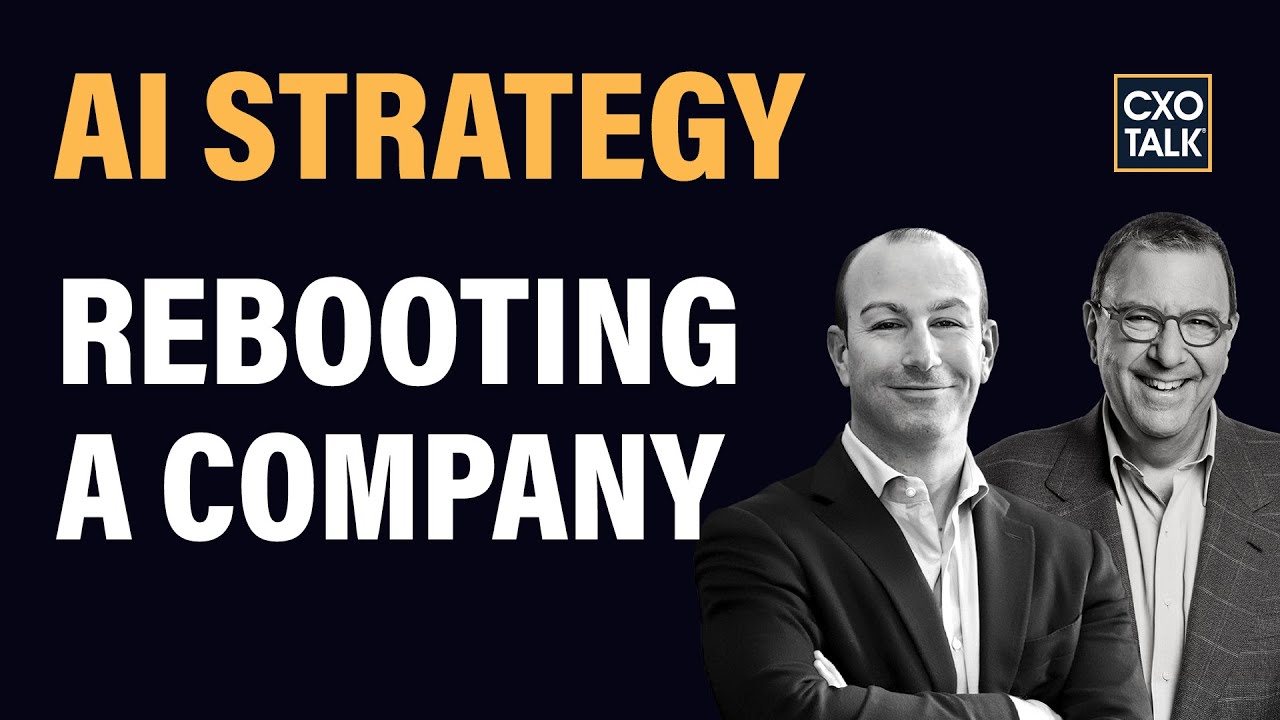
In CXOTalk #901, Hexion President and CEO Michael Lefenfeld explains how a 150‑year‑old industrial manufacturer is working to become an AI‑first company. He discusses the real-world opportunities and constraints of applying AI to manufacturing, supply chain, and product development to transform a traditional industrial business at scale.


Related Episodes
Please support our episode sponsor:
Explore executive education programs from Emeritus, in collaboration with top universities.
======
How does a 150-year-old industrial manufacturer reinvent itself as an AI first company? In CXOTalk episode 901, Hexion President and CEO Michael Lefenfeld discusses how the global chemicals and materials producer is rewiring its business model, operations, and culture around data and artificial intelligence.
Hexion’s roots stretch back more than a century, yet it now competes on digital speed, intelligent automation, and science-driven innovation. Lefenfeld describes the company’s efforts to embed AI into manufacturing, supply chain, customer engagement, and product development—while still meeting industrial expectations for safety, reliability, and sustainability.
Topics we cover include:
- Why Hexion chose an AI first strategy and how it connects to business growth and sustainability
- Rewiring manufacturing with autonomous and predictive capabilities
- Using AI and advanced analytics to improve safety, quality, yield, and energy efficiency
- Building the data, platform, and organizational foundations for AI at scale
- Managing talent, culture, and change in a traditional industrial setting
- Lessons learned, pitfalls to avoid, and practical advice for other established manufacturers
This episode provides practical, experience-based insights into what it takes to transform an industrial incumbent into an AI-driven, innovation-led enterprise.
Join the live conversation to learn, share your views, and ask questions!
Episode Participants
Michael Lefenfeld is President and Chief Executive Officer at Hexion Inc. He is also Chairman of the Board of Directors of Hexion Inc. and serves as a member of the Board of Managers for ASP Resins Holdings LP. Michael joined Hexion in January 2023.
Michael Krigsman is a globally recognized analyst, strategic advisor, and industry commentator known for his deep business transformation, innovation, and leadership expertise. He has presented at industry events worldwide and written extensively on the reasons for IT failures. His work has been referenced in the media over 1,000 times and in more than 50 books and journal articles; his commentary on technology trends and business strategy reaches a global audience.
Related Episodes
In This Episode
Introduction to Hexion and Its Role in Everyday Life
Michael Krigsman: Why spend millions on AI that helps customers buy less of your product? Sounds like bad math, but Hexion CEO Michael Lefenfeld says, "It's the way to escape the commodity trap." I'm Michael Krigsman. Welcome to CXOTalk number 901. Let's get into it.
Michael Lefenfeld: Hexion is a company that every person pretty much in the world interacts with every day, but they just don't know it. We make products that make products better, as BASF used to say. We make the adhesives that go into wood panels. So you think OSB, plywood, it's a bunch of pieces of wood glued together. We make all the adhesives around the world among that space.
We make fertilizers for agriculture. We make oil and gas purifying products. We make coatings and paints and things along those lines that make those products better. So we touch the surfaces, the materials. Everything you interact with every day has some Hexion brand to it.
Michael Krigsman: So you're kind of hidden behind the scenes, as it were?
Michael Lefenfeld: We are. Hexion is a B2B business, so Hexion doesn't end up on a product name when you're buying it, but it is enabling the product you're using.
Hexion's Integration of AI Across Operations
Michael Krigsman: What I found so fascinating is your emphasis on AI. Give us some insight into, what is that? Why are you using AI? How are you using AI, and so forth?
Michael Lefenfeld: Hexion's a 150-year-old company. We've got a lot of materials, a lot of processes, a lot of formulas, a lot of excellence in what we do, and AI is an enabler to that. AI allows us to take the best and make it even better. That is really the critical push for AI.
We use it to look at all people in our organization. As you can imagine, in any role, in any job, there's a bell curve of quality of people and performance. There's some lesser performers, some really substantially productive performers, and then there's an average in the middle of that bell curve ranging from good to bad.
What AI enables is taking everybody on the lower side of that bell curve and making them the best they can be if they use it in the right ways. That's how we enable AI throughout the entire organization of Hexion and how we also use it to make our products and the solutions for our partners and our customers even better.
Michael Krigsman: Now let's take a moment to learn about Emeritus, which is making CXOTalk possible. If you're a business leader navigating change or driving growth, explore executive education programs with Emeritus, a global leader. They offer programs developed in collaboration with top universities designed for decision-makers like you. There's a program tailored to your goals, whether that's AI and digital transformation or strategy and leadership. Find your program at www.emeritus.org.
AI as a Tool for Growth and Empowerment at Hexion
Michael Krigsman: So it sounds like you are infusing AI through your operations in a both a broad and a deep way.
Michael Lefenfeld: Yes. Every person at Hexion is empowered to utilize AI. When I first started here, I used to get emails from my associates in my organization and say, "I did this work. I didn't use AI to do this. This was my work." And I'd write back to them and say, "Why do you feel that that's a exception using AI and not the rule?"
When we go to the doctor and we ask the doctor to diagnose us, we want them to use all the tools at their disposal. You don't want them just to listen to your heart and listen to your lungs and then guess what may be wrong with you. You want them to use every system and equipment to make your diagnosis better. And at Hexion, we're the same way. We wanna use all the tools that are enabling for us to do the best work that we can. So AI needs to be championed at every level throughout the organization.
Michael Krigsman: Can you drill down and give us some examples, make this concrete? And the reason I'm asking it this way is because everybody talks about AI. There's so much hype, and everybody says, "Yeah, we're investing in AI," and the words do not necessarily indicate the reality underneath. And I know for you, this is very serious, so please dig into this for us.
Michael Lefenfeld: Innovation at Hexion is a critical growth lever that we utilize, and so if you think about an entire research organization, AI is an incredible enabler. There is a lot of new science published every day. There's hundreds, thousands of patents and papers and presentations and journals that are given and released on a daily basis.
If I had my scientific team having to read every one of those papers, every one of those patents, every one of those publications to basically determine if it could be helpful through our innovation pathway, they would never have time to be in the lab or in the research facilities doing the work that we want them to do to make products better.
So we utilize AI directly in that role to scan a wealth of data that would never be able to be done by single individuals, and then summarize it. And then they can take that summary and say, "Oh, this really hits home for what we're trying to do." And they can then take that paper and read it more in depth, look at the figures, look at everything that's enabling you to it, and then allow them to take their strategy forward using that new learning. AI isn't a learning tool, and we want people to use it to educate themselves, think bigger, ideate farther, and really be capable of expanding their own boundaries.
Michael Krigsman: Do you ever receive resistance from folks who you're asking to adopt these tools and these new ways of working?
Michael Lefenfeld: Of course. You receive resistance for pretty much everything that you try and put into an organization that's changed. Change management is critical to an organization and making sure you do it properly. One way we got around that sort of reticence to adopt AI, we did an AI challenge at Hexion. First prize was $50,000 to a person or to a team that came up with an AI solution to one of the problems that we have.
And so we look at enabling people, whether they're subject matter experts, whether they're doers and coders and data and analytics experts, we want all of them to participate in that AI push in the way that their strengths lend to it. In the people that have been in the job for a long time, they've got a way of doing it and they have a process that works for them.
But it doesn't necessarily remain enabled through the best technology that's out there, automation and manufacturing, speed of data processing and being able to tweak the reactors and the products in a way that is using all the information instead of going into a report, but going into something that's giving you informed information to help you make decisions. And that's how you get them to really lean into it, because they'll see the enablement that it causes.
Michael Krigsman: Now let's quickly hear from Emeritus, which is making CXOTalk possible. If you're a business leader navigating change or driving growth, explore executive education programs with Emeritus, a global leader. They offer programs developed in collaboration with top universities designed for decision-makers like you. There's a program tailored to your goals, whether that's AI and digital transformation or strategy and leadership. Find your program at www.emeritus.org.
So there's a cultural shift that takes place, I'm not trying to put words in your mouth, where you are driving the use of that information that comes from the AI to actually take action steps and incorporate those learnings directly into the workflow.
Michael Lefenfeld: That's exactly right. So AI doesn't have to be the doer of everything. Everything doesn't have to be made to be autonomous and automatic. What it can do is also a recommendation engine. It could say, "Hey, this data is looking in a certain way. You may want to tweak a process condition to make something better."
And this is what also enables our Smartech technology that we commercialize out into the wood panel manufacturing industry. We give users and operators that use our software recommendations to make their line work faster, work smarter, use less material. That's where AI is really an enabler to complement it with the know-how of the people that have been doing the job for so long and have so much know-how and information, and pair it with the data processing power that is unmatched by a computer. So you bring those two together and you have a really perfect storm.
Michael Krigsman: Folks, you can ask questions. If you're watching on LinkedIn pop your questions into the LinkedIn chat. If you're watching on Twitter, X, use the hashtag #cxotalk. We're speaking with the CEO of a large chemical manufacturer, Hexion. When else will you have the chance to ask someone like Michael Lefenfeld pretty much whatever you want? So I urge you, take advantage of it.
And we have a very interesting question from Twitter from Arsalan Khan, who's a regular listener. Arsalan always asks great questions. And he says, "What sort of disincentives and incentives do you have for people to adopt AI as a partner rather than a job taker?"
Michael Lefenfeld: We don't look at AI as a job taker. We look at AI as basically an improvement to the skillset. But we want every employee at Hexion and anybody that we hire to have some AI experience. And I don't mean they have to know how to build an agent. I don't mean that they have to know how to code a language model. What I'm saying is that they have to know how to utilize a proper prompt to get the information and be able to get their ideas and expanse out there. So that is a critical foundational lever for us.
Now if they're truly against using AI, we can and have found roles for them in subject matter expertise to inform those that are more capable in the AI, to build their systems knowing what they do every day and how well they do it, and being able to translate it into that space.
Now, we don't also at Hexion look at AI as a job replacer. We're not looking to cut headcount. That is not in our strategy at all. If somebody develops an AI agent or application that replaces their job, that would be phenomenal, because that person will be an enabler for more parts of the organization to bring an AI thought process all the way through. So, that person has probably a promotion on their hands, not a job loss, if they're able to do things like that. So, at Hexion, we use all enablement. There's very little stick. There's only lots of carrots when it comes to AI at Hexion.
Michael Krigsman: Michael, you must acknowledge that there is real concern out there that as AI drives efficiency, there will be a temptation to eliminate certain jobs, because you can.
Michael Lefenfeld: I am not a grow by cutting CEO. I was chosen by the board to come into Hexion through a transformation for growth. My background is entrepreneurial. My background is growing new products. I have patents.
Leadership Philosophy and AI Integration at Hexion
Michael Lefenfeld: I've brought new things to the world throughout my career. So, I am not the one that would be here to ultimately go through headcount reduction processes and look at that. Now, look, I will tell you, AI has enabled us to save money and do things better and more efficiently, but the headcount at Hexion is not at risk from the AI component.
If anything, if we're freeing up time of individuals to do more, they'll do more. We have a lot of goals and a lot of plans in how we're looking to expand Hexion into doubling our size and our revenue and our ultimately, profit. But that is the goal for Hexion, is just for growth. And that is what we are enabled to do, and that's a strategy we have.
Michael Krigsman: And I will mention, you have over 100 patents and pending to your name as well.
Michael Lefenfeld: I do, yes. I am a nerd. It is the single descriptor word that works almost perfectly every time if you wanna describe me.
Michael Krigsman: It sounds like you have a different attitude towards AI adoption than many other CEOs who are looking at it through that lens of efficiency and reducing headcount as a result of automation.
Michael Lefenfeld: Through my entrepreneurial early parts of my career, I've done every job. I'm not gonna say I can do every job, but I had to do every job at the time. I wasn't great at all of them. But in any one day, I could be scrubbing toilets and meeting with a president or a CEO in the same day.
So, I spent time in supply chain. I spent time in procurement. I spent time in operations. I spent time in finance. All the different roles in the organization. So, as a CEO of now Hexion, a global, large, billion-dollar organization, I'm able to enable a lot of different functions with some very simple questions, because I have an experience level in every role that I can be a little more intriguing and lead to a little more creative thinking that comes from my background and my experience.
And that's really what's been I think what's taken Hexion to that next level as quickly as we have in the last couple of years. Wood panel engineering and building and construction products are our bread and butter. We are leaning into that in a very big way, in a new way that hasn't been done before. And we think our partners and our customers are seeing that too.
AI's Role in Safety and Decision-Making
Michael Krigsman: We have a question, an interesting one from Nandeep Nagarkar, who says, "What guardrails do you have?" So, when it comes to your AI, how do you think about the guardrails?
Michael Lefenfeld: AI does need some human interaction at least at this stage in time. We don't let anything run without some user feedback to it. But there are ways to build AI agents and models that do have its own checks and balances, but there is, I still think at this point in time, there is still a need for the human check.
And so we don't run anything at Hexion singularly with AI exclusively. We have all human interaction still to double-check the results and make sure that we're not leading anything in the wrong direction. Mind you, we handle some pretty hazardous chemicals as our starting materials, and we wanna make sure that we're doing everything right. We're working with temperatures and pressures and different things to make different molecules. And because of that, we like to make sure that we have our human interaction in there as well.
Michael Krigsman: So for you, it's not just the issues around AI ethics, but it's actually issues of relating to scientific accuracy and safety?
Michael Lefenfeld: It's everything. You have to be thoughtful around any new technology. So I'm a very big believer in utilizing new technologies quickly and often. I also believe that a lot of decisions in a work environment, a lot of them are reversible decisions, and my team has heard me say this a lot. If it is a reversible decision, so usually if you know the cost of the reversibility, it's usually time or it's money. If you can afford that cost of reversibility, you should just walk through the door.
And if it doesn't work, you'll learn something. You'll be able to put it back together, and you'll build Humpty Dumpty back together again with more learning and in a better way because of that learning. And that, to me, is a really important feature to being able to grow an organization with new technologies.
That also being said, I will never be cutting edge when it comes to safety. Safety is number one at Hexion, and safety should be paramount in every organization. So especially with what we do and even in AI capabilities, we wanna make sure we are safe in everything we do every day.
Michael Krigsman: We have another question from LinkedIn, another interesting question. And folks, keep your questions coming. Take advantage of this opportunity to ask the CEO of a major manufacturing organization pretty much whatever you want. We're talking with Michael Leffenfeld, the CEO of Hexion. And this is from Anoop Rama, and Anoop says, "How do you measure your ROI, especially when you're implementing AI in a chemical manufacturing environment?"
AI-Driven Efficiency and Learning in Manufacturing
Michael Lefenfeld: There's numerous KPIs that come with that, depending on where you're using the AI. In my team, in my back office team, it's productivity. They're getting so much more done in less time. They're able to do more. They're able to think more.
I have a leadership coach that often tells me you have to spend time on the balcony as well as on the dance floor. And what that means is that you have to be able to see the forest for the trees at times. And in my leadership team, the higher the leader in the organization, I want them more time spent on the balcony and less time on the dance floor doing the tactical work. And then as you move throughout the organization to the roles that are more tactical, they're spending more time on the dance floor and less time on the balcony. So AI really enables that capability to be able to stretch yourselves into the breadth that comes with an organizational work.
But if you're talking about AI and automation in manufacturing, you see lower raw material consumption. You see faster batch times. You see better quality and better product. At the end, you see lower energy consumption. It's truly sustainable. AI enables us to run towards what we call the golden batch, the perfect batch. And if you can lower the cost of raw materials, that's great for the customer, but if you can lower the consumption of energy or lower emissions or decrease scrap or waste, that's better for the world. And that's really what we care about at Hexion.
Michael Krigsman: Let's drill into this point. How does AI help you lower these costs and drive towards that perfect batch?
Michael Lefenfeld: I'll utilize our Smartech technology. That goes to a customer 'cause that, I think, is a great example for us. So we have a AI technology that gets installed into every unit operation. So the way that a wood panel is made is you take a tree. You debark it. You eventually you treat it. You cut it into small pieces or strips. Then you dry it. You add our adhesive to it, our resins to it, and then it goes on a mat. And it gets pressed with heat and pressure into the board that you see at the end, and then it gets inspected for quality.
So our smart tech systems go into the specific unit operations. We have parts that... Right now, we have overlayers that go into the press, which is the heat and pressure that gets applied. Now, that heat is generated by steam, so you wanna make sure you're using the perfect amount of steam so that you're not generating any CO2 when you're generating that electricity or that heat that comes along with it. We have a smart quality product that basically makes sure that the product is in the right first time so that you can go back into your line. If product is not coming out well, you're not generating more waste. You're able to go back and fix in the plant itself.
And then we have a product called the smart strainer. What a strainer is is basically the knives that chop up the wood into the pieces that you need. So our AI software for that unit operation allows you to get the best consumption of that tree you can. So you're using less trees, you're having less waste, and you're making sure that the product quality is exactly where it should. Because you're making sure the knives on the cutter, on the strainer, are not dull, they're not vibrating, they're not causing bad cuts. So you're making sure that every cut is the right cut.
So if you think about first time right is what AI can enable by taking that data, that information, instead of putting it into a data historian where it's gone all these years. It now brings analysis, interpretation, and suggestion for it to run properly. Now, you can always run autonomously, but we prefer to run with a recommendation engine. We do enable the autonomous, but we prefer the recommendation engine. So operators and their expertise of knowing their line and how their line operates, make sure it works. And this does lead to us using less consumables, which is a savings for everybody, the world and for the customer.
Michael Krigsman: So in this case, the savings and the efficiencies derive from real-time or near real-time data analysis, and the ability to make adjustments along the way, as opposed to increasing the knowledge, the general knowledge of the people working at Hexion.
Michael Lefenfeld: That's not exactly right. Yes, it uses data to make sure that you're putting your parameters in the best place possible, but it's also providing learning to the operators at the control board. So where they're sitting and adjusting and tuning and doing all the things that need to get done, the AI tool is telling them, "Hey, have you thought about this?" And that's a training system.
So you have to think about the AI recommendation tool as also making your operators learning as they're performing the task, because they're getting data analysis. Now, they have a gut feel. Some operators are brilliant when it comes to that gut feel interpretation as they're seeing different trends along their production line. But the AI engine can also now tell them, "Hey, you didn't notice this." So let me give an example on a personal front for me.
Personal Experience with Diabetes and Continuous Glucose Monitoring
Michael Lefenfeld: I'm a Type 1 diabetic. I've been a diabetic for almost 40 years. And let's call it about a decade ago, I started using what's known as a CGM, a continuous glucose monitor. It's in my body and it tells me my blood sugar in real time. I run my blood sugars like your body runs its blood sugars. But I learned things that I thought I was doing right all these years. When I ate certain things, my blood sugar reacted differently. It's a learning tool that says, "Oh, if I eat that, it's gonna change my blood sugar in a different way than I thought."
It takes longer to digest, it takes longer to absorb. Sometimes exercise raises my blood sugar. You know, if my parents see this video, I could tell you, my mother used to take me when... Before I had soccer tournaments as a kid, they used to take me for ice cream as a surprise 'cause I was getting all this exercise. But what it turns out is when you start exercising, your blood sugar actually goes up. So she was giving me ice cream, which was raising my blood sugar, and exercise, which was raising my blood sugar. Wasn't probably the best combination, but I only learned that with a CGM. And so it's that type of tool now put into wood panel processing, chemical manufacturing, that gives you that learning ability that's different. So it's a trainer, not just a doer. And that's really critical.
Michael Krigsman: So it's the combination of data analysis combined with learning, essentially.
Michael Lefenfeld: Exactly.
AI's Role in Customer Service and Business Operations
Michael Krigsman: We have a question from Drew Jackson on LinkedIn, and Drew says, "What use cases relating to customer service and client-facing roles do you see AI having the largest positive impact on?"
Michael Lefenfeld: AI in customer-facing and customer service is actually pretty important. As you can imagine, developing products for the customer comes with a skill of voice of customer. You want to get all that feedback from them first. But also, it helps with strategy. You can use an AI agent to or just a simple AI system to help yourself to go through the sales process.
What kind of questions could be asked? You could be you could sharpen your ability to do the sales pitch, to tune your capability to make sure that you highlight things that may be important to them, 'cause you can use an AI agent to then say, "Hey, what's most important to this customer? What have they been putting out in their press releases, their shareholder documents? What are their mission-critical goals for this specific year?" And then you can craft your sales pitch directly.
So you can use it as a give and take to build that strategy on how to deliver sales excellence along that. But you can also use it for strategic marketing and data gathering. You use it for, like I said, for voice of customer, for customer service help. So you have at your fingertips you can gather that information that Hexion has hundred plus years of information on some of our products, that we can pull that dated information in a much more realizable way to make sure that everybody can answer questions in the most informed positions.
Michael Krigsman: To what extent have you applied automation in areas such as your contact center?
Michael Lefenfeld: We have enabled our teams with tools to be able to reach through to our SDSs, our safety data sheets, right? Into the specific product stewardship sheets that are needed. We wanna make sure that they have permit access. They're able to reach much further than they used to into the trove of information that Hexion has for every one of its products and every one of its solution offerings to our customers, to make sure that they have the best service that they can give our customers immediately.
Michael Krigsman: We have a question from Alfonso Velasco who says, "AI in manufacturing can be applied both on the front line, the shop floor, and in the back office, accounting, sales, customer service, logistics. What are the most exciting use cases Hexion has deployed in the latter?"
Michael Lefenfeld: In the back office, AI is a critical tool in our supply chain excellence and our procurement excellence, to make sure that we're looking at... Especially in today's day and age where trade lanes are changing quickly with all the geopolitical, macroeconomic movers that are happening in today's day and age. So, using AI to enable those pathways to make sure that we can serve our customers without incident, without delay, without any challenge is an area where AI and that enablement really does return on that investment pretty quickly.
And then there are just simple things, right? Reporting financial information. Using AI allows us to much, much more quickly put together reports and analyses that are needed for a large organization. We're not public, we're a privately held organization, but public organizations as well are constantly churning that information for the needed shareholder. And we use tools like that every day.
AI Learning, Ecosystem Collaboration, and Organizational Growth
Michael Krigsman: And this is from Greg Walters, who says, "Okay, speaking of learning, instead of the AI teaching the human, isn't the AI itself learning beyond the human?" And I guess we could extrapolate that question to the whole issue of the AI taking in your data, and do you have concerns about that?
Michael Lefenfeld: The AI systems that we use are not publicly trainable to open AI or Gemini or the systems. They are kept internally. They are firewalled, and we do make sure that our data and our know-how and our intellectual property stay very secure. So, I am not super worried about that as an issue.
But look, the AI should learn. You want it to learn. You want it to learn on the data of our processes and our different actions throughout the organization in every function and make sure that we're utilizing it into... So that it's continually learning new scenarios, new ways we do things, new things we're looking at. Because as we're a growing organization, we may try to enter into different markets and different industries as we go about. So, we want a learned system. We just don't want a uncontrolled system, and we want a secure system around that.
Michael Krigsman: You want a system that learns but that doesn't share outside the boundaries of your organization?
Michael Lefenfeld: Yes, and then we make sure we put those firewalls in place as needed.
Michael Krigsman: We have some great questions on Twitter. Isn't the audience fantastic? I mean, the questions we get are just wonderful. So again, this is from Arsalan Khan. He says, "A company is not an island. How do you encourage your ecosystem of vendors and partners to become AI ready, too?" And I'll just add to that one, and what happens if your ecosystem of partners does not become AI ready to that extent?
Michael Lefenfeld: As an organization of Hexion, as we transform into basically a cutting edge organization delivering new products and new solutions for our providers, it's sort of Rising tide raises all ships. We make sure that we communicate what we do and how we do it, and we share this information.
And AI is an area that everybody is inquisitive about and everybody sees value in. I truly believe that is not a question through organizations. Now, some move at different paces, of course, but the AI use at Hexion does allow us to move quick. And I think those that are providing us, they see the growth that we're making, they see the differentiation we're leading, and they wanna make sure that they could stay along. So, you do see them try and adopt, or they ask questions on how they can adopt, and we partner with them so that we can help them transform as well.
Michael Krigsman: Sounds like you are very much a carrot rather than a stick kind of leader.
Michael Lefenfeld: I would say that. I'm not sure all my employees would say that. But, look, in this area, when you're trying to get people to grow, you're trying to learn, you're trying to give them the skills to be successful. You know, Steve Jobs said, well, "What happens if you train your people and they leave, but what happens if you don't train your people and they stay?" And that paraphrasing, but that is, it's, we want the best people in our organization. We want to enable them, we wanna pay for their education, we do that regularly.
We want them to be the best they can be. And hopefully they stay, but if they go somewhere else, we'll have a pretty good reputation for great people. And I think that's just as important because the brand of Hexion is bigger than just the products we make. It's also the people that we bring forward into the world.
Michael Krigsman: Very interesting how you talk about the brand as being beyond just the product, but it's really the broader reputation of the organization, of the company.
Michael Lefenfeld: Yes. 100%. Hexion's been around for 150 years. We weren't always called Hexion, but we've been around for 150 years and the culture and the institution and the soul is not something that I can change. I can only help make it bigger and more modern to where it is today. And my team is amazing. I have one of the best teams in the world, and they don't stop. We have a saying at Hexion, "We strive for perfection knowing we're never going to achieve it, because we're gonna constantly raise the bar and constantly try and achieve the next milestone." And my team over delivers every time.
Michael Krigsman: Your respect for the DNA and the history of the company really does come through.
Using AI to Enhance Manufacturing and Investment Decisions
Michael Lefenfeld: Thank you. I hope it does.
Michael Krigsman: We have another interesting question, again on Twitter, and this is from Russ Bankson, who says he's interested in acquiring and growing small manufacturers. How can he use AI to understand their current processes and suggest innovations to improve their processes and new products?
Michael Lefenfeld: AI is then a tool that should make that analysis and the diligence of those organizations in a really efficient way. You don't need a big team to do that. But you can benchmark really well using AI, you can see where the markets are going and where they're growing and where some headwinds or tailwinds exist.
There are big private equity firms around the world that utilize AI to help see how they may have bought something and made a mistake and why they made that mistake. Or how they made an offer for a company that they didn't make an offer to a company and they said no to that and then they saw it later become something that they'd never had in their model. So there are, there is a constant growth in that space for using AI and the information it can generate, and enable those to make more informed investment decisions. But I can't really opine more on that.
Hexion's AI-First Strategy and Customer-Centric Approach
Michael Krigsman: We have a question, again still on Twitter, from Lizbeth Shaw who says, "What does being an AI first company mean for Hexion today and what does that look like?"
Michael Lefenfeld: We want everybody to have AI as a enablement tool for themselves. So that's what it means. It means that everybody that comes into Hexion has to get comfortable with some use of AI. Now it could be a native application in a software that we already have installed. It could be using a just a prompt engine to be able to better build their data acquisition. Or it could be building actual agents and actual tools in the organization.
But there is no real limit as long as AI is a willingness in your toolkit. My job as a CEO is to give all of my team the tools to be successful. That is really the number one job in my day is to make sure that every person on my team has the tools to win. And AI needs to be one of those tools that they can utilize to help them win.
Michael Krigsman: When you repackage AI or use AI for your customers in order to significantly reduce their materials usage, that cuts into your bottom line, right? You're selling them less. How do you reconcile your profit making goal with your let's sell the customers less than we did before goal?
Michael Lefenfeld: Michael, it sounds like you sit on my board. That's exactly right. We are putting tools in place at our customers' to make sure they're using the right amount of our products. But that's going to happen whether it happens by Hexion doing it or some other organization doing it. It's gonna happen one way or another.
At least I have the tools now that will enable us to get better because the information that we're gaining by letting our customers use less wood, less energy, less resins that we sell, less waxes that we sell. The reason that they can use less is because it's the right amount in the right conditions to make the best product. But that data then comes back to us, it's screened, it doesn't combine with other customers, but that singular customer then allows me to understand their process better so I can deliver them a formulation that is exceptional compared to anybody else out in the world that may try and supply that same product.
Because I know intimately how their process runs, what the conditions are, what their substrates look like, what the surfaces may be, what the speeds they're running at. I can use all that information to custom design my products so they have something every day that is unique to their platform, and allows them to have the best product in the world in what they're making. Nobody can say they can do that. And I'm not saying we can do that just today, but we're on our way there. And we are starting to show that return already, even in the early phase of our AI transformation.
Michael Krigsman: It sounds to me that the calculation you're making, and please correct me if I'm wrong, it sounds the calculation you're making is fundamentally a trade which, on the one hand, we will use data to let you reduce your cost, let you reduce, become more efficient, can buy less from us, and do an even better job because it's the right thing.
In exchange, we are gaining data about you, the customer, that lets us serve you better than we could before. And by knowing your business and what you need that much more thoroughly, we're assuming that we'll be able to be a better supplier, a better partner to you. And in aggregate over time, the relationship will deepen between our companies and, in fact, we'll sell you more.
Michael Lefenfeld: Exactly. That's 100% correct. It's not exactly a trade, but we are trading those things so we can expand our offerings to each customer so that they can have more from Hexion, more support because of what we're doing with the systems that we supply with the product solution that we offer that we can expand that into their other parts of their business as well. And that's how we look at it.
Michael Krigsman: So from your perspective, it's a deepening of the relationship based on shared data, essentially, that benefits both your customer and Hexion.
Michael Lefenfeld: Yes. Everybody talks about how they have an intimate relationship with their customers and their partners, but this is a much deeper intimacy because you're able to help them to be successful in the best way possible. By ultimately giving the most sustainable solution they can possibly have because they're using less, they're wasting less, and they're bringing that to the communities that they serve and the markets that they sell into all that much betterment.
Michael Krigsman: And when you use the term sustainable in this case, it sounds like what it actually means is a combination of cost-effective as well as higher quality or better fit to purpose.
Private Equity's Role in AI Investment and Long-Term Growth
Michael Krigsman: Michael, you are a private equity owned company. Has that relationship changed the way you think of investing in AI? In other words, either has it restrained the amount that you could invest in AI or has it forced an acceleration of that investment because the time horizon of private equity is limited, and you need to show results?
Michael Lefenfeld: American Securities is our PE owner, and they are absolutely fantastic. They have empowered me to think not just within their hold period but to think about the business for 100 years forward. They are not limited to the time constraint of, like you mentioned, the hold period where they look for their investment and the cash flow. They want us to build a business that is going to be longstanding for a future owner to basically be able to grow and continue to grow forward.
So American Securities enables me to be incredibly rapid in my movements. I'll give a little bit of history here for American Securities. They have an entire operations group, 100 people, that they provide to us, they pay for, that allows us to borrow from those people. They're experts in legal, and they're experts in IT, and they're experts in procurement and supply chain, you name it.
But what that does is it allows me to experiment and try different things without having to truly invest in hiring somebody, taking them away from a job they may be in and then find out that idea didn't work. And I would never wanna pull somebody out of an organization and then tell them they have to go look for a job. That's the worst thing a CEO could ever have to say to somebody.
And so, what American Securities enables us through their resources group is to experiment. And their IT team is phenomenal. They own AI companies. Now, going and buying AI companies, the valuations may not necessarily lean themselves to a perfect synergy with PE. But they own AI, they know AI, they're using AI. So they're really enabling and really looking forward to the solutions that we're providing because they then share it with the rest of their organization as well. So, I think it's been a really synergistic relationship between Hexion and American Securities because they are pushing for growth every way they can.
Michael Krigsman: So, clearly, the AI-first strategy that you've adopted fits with their thinking, and it sounds like you're very much mutually aligned around that.
Michael Lefenfeld: Yes. Very much so.
Michael Krigsman: And I really encourage people who are listening to think about this, which is the notion of using the data to create a win-win situation with your customers, where you are helping them be more sustainable. In exchange, that data enables you to develop a deeper understanding of their business, which creates really a one plus one equals three because you're increasing the size of the pie based on that data.
Optimizing Products with Data and Batch Chemistry
Michael Lefenfeld: That's exactly what it is. By us having that data, it allows us to generate products that are specific, that are designed for them. The adhesives in the wood panel industry, in the wood industry, are made in what's known as batch chemistry. So, big stir tank reactors, opposed to continuous flow where, like, petrochemicals and oil and gas are refined, things like that.
So, because we do things in batch, we have to do... Sometimes, to a specific wood panel plant, we can send six deliveries a day, have to run three batches a day. So, with their constant change in environmental conditions, in their wood substrate conditions, with their line conditions, with their heat conductivity in their press may get worse and worse over time, may need to do some modifications. We know all that, so I can give them a resin that's going to perform at the optimal conditions. And those optimal conditions make sure that they have the best product every time. And that's the goal. And that data is symbiotic between us and them to make sure that we're all getting to the best place we can, every single time.
AI's Impact on Business Models and Lessons Learned
Michael Krigsman: We have a question again from Lisbeth Shaw, who is asking about the business model. How has AI changed your business model?
Michael Lefenfeld: The business model has not changed just yet, but we do see there will be ways to expand the business model between... You know, with a service component as not just a chemical materials sales process. So we do see enablement in being able to deliver value in other ways through service and through other exceptional models throughout. But I do see Hexion, and we already have started expanding beyond just the we sell you a product, and you use it to go forward. We are now getting into a more integrated value proposition with our customers.
Michael Krigsman: If you could go back to the start of this AI transformation, what would you do differently?
Michael Lefenfeld: I can't tell you exactly what I've stubbed my toe on, but we've stubbed our toe plenty of times. But like I said, they're reversible decisions, and you learn from those reversible decisions. So I was able to go back, reverse, and do it again in a smarter way.
So, I don't think it... Because AI is we're sort of building the plane while flying it. 'Cause AI is evolving so quickly. It is amazing the speed and the capabilities that are coming along with AI. So we're just, we're trying as we go, but we're not afraid to make mistakes. That's okay. You learn from them, and you try again, as long as you're making sure everybody is safe along the way.
Advice for AI Implementation and Closing Remarks
Michael Krigsman: So many companies are stuck in AI pilot purgatory. What advice do you have for other business leaders who want to get out of the pilots and into practical AI benefit?
Michael Lefenfeld: Just try it. Speed is important. You really do have to keep up with what's going on in the world. It's moving incredibly fast. And if you can't do that, you're gonna be left behind because somebody is going to move faster than you. There's a famous saying, right? "Every great idea is one in a million."
But people don't do the math past that step. Every great idea is one in a million, but there's eight billion people on the planet. So at any moment in time, 8,000 people have that same exact great idea. So if you're not moving fast, if you're not executing quickly, if you're not bringing the smartest people to the problem and working as a team because you get there faster as a group, you're gonna get left behind because that other one of those 8,000 people is gonna be faster than you, and you're gonna miss out on your opportunity. So to me, that is critical.
Michael Krigsman: So in other words, just get it done. Get it done.
Michael Lefenfeld: Just try it, and get it done.
Michael Krigsman: And with that, we're out of time. A huge thank you to Hexion CEO Michael Lefenfeld. Michael, thank you so much for being with us. I'm very grateful to you.
Michael Lefenfeld: Michael, thank you so much. This was wonderful. I really appreciate it. And anybody who asked questions, if they have more questions, can reach out to me on LinkedIn or reach out to our marcomm team, and we'll get you answers.
Michael Krigsman: That's an invitation. And folks, if you're listening, definitely connect with Michael on LinkedIn, connect to me on LinkedIn. We have great shows coming up.
Do not forget to subscribe to the CXOTalk newsletter. Go do that now so we can notify you and you can participate.
Thanks to everybody who watched and asked such awesome questions. You guys are fantastic. See you again next time. Have a great day, everybody. Bye-bye.